Enterprise AI Adoption Guide — How to Deploy NVIDIA Agentic AI in Production
From curiosity to deployment: practical 4-phase guide (Evaluation, Pilot, Scale, Governance) for integrating NVIDIA agentic AI in production. Real cases, mistakes to avoid, 20-point checklist.
Introduction — From interest to production
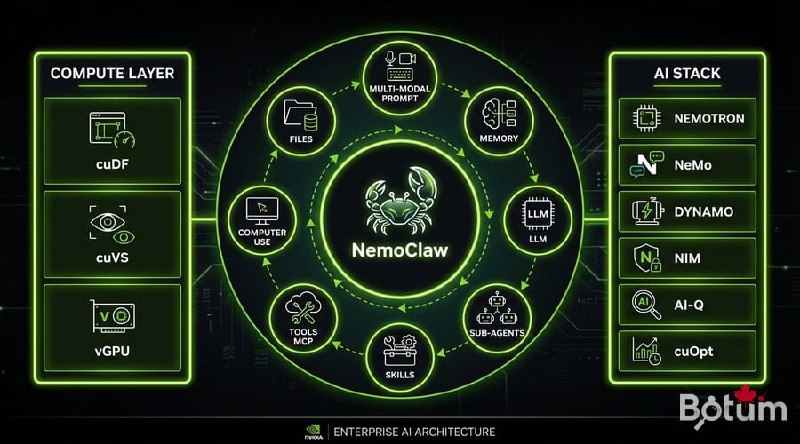
At GTC 2026, NVIDIA confirmed that agentic AI is no longer a lab topic: it is a production reality. NVIDIA Agent Intelligence Toolkit, NIM, NemoClaw, agentic Blueprints — the building blocks are here. The real question is: how does your organization move from curiosity to deployment?
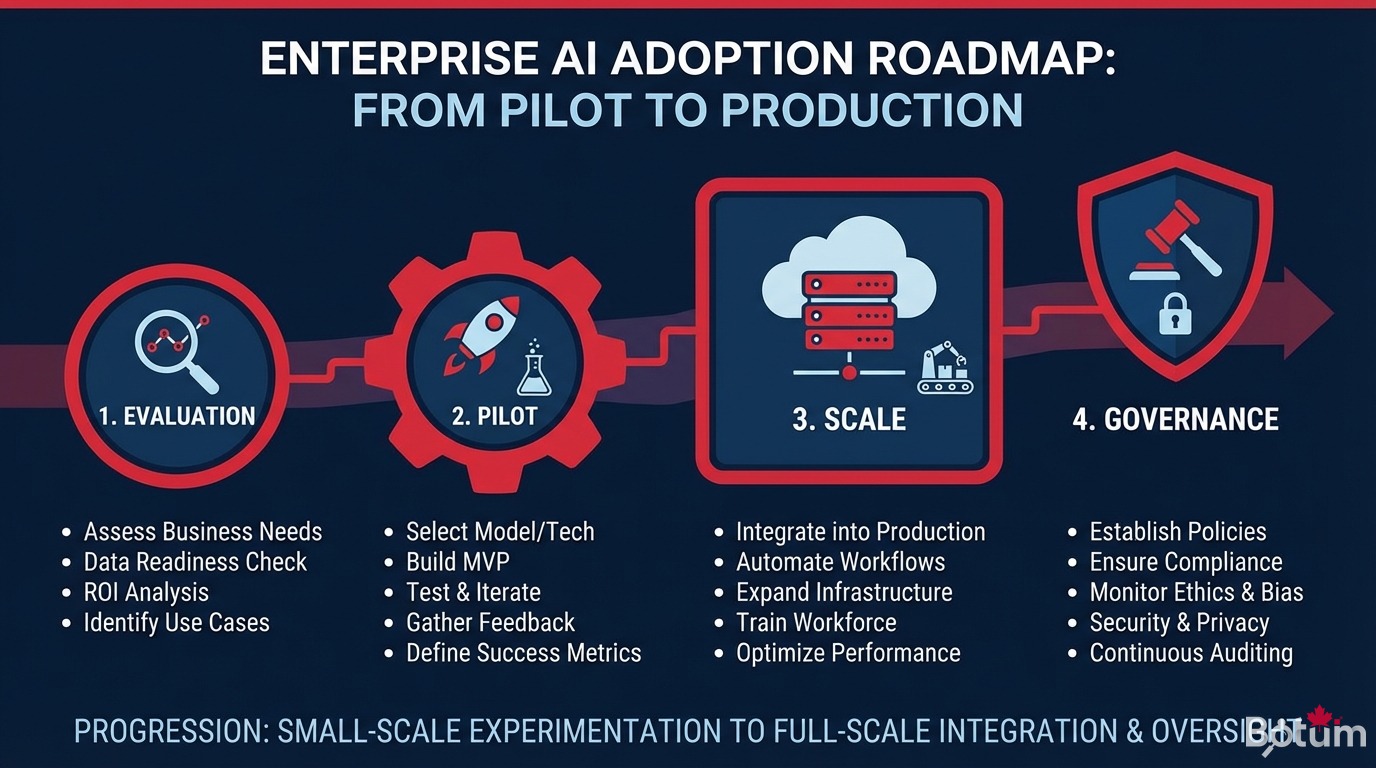
This guide targets solution architects and CIOs who need to make concrete decisions. It structures the journey into 4 phases: Evaluation → Pilot → Scale → Governance. Each phase includes precise actions, success criteria, and pitfalls to avoid.
GTC 2026 Series
Phase 1: Evaluation — Identifying the right use cases
Most enterprise AI projects fail not because of technology, but because of a poor use case selection at the start. Evaluation must be methodical.
Pilot use case selection criteria
| Criteria | Good sign ✅ | Bad sign ⚠️ |
|---|---|---|
| Task volume | > 100 repetitive tasks/day | Rare or highly variable tasks |
| Data quality | Structured data available | Siloed or missing data |
| Error tolerance | Error = negligible cost | Error = legal or security risk |
| Measurability | Clear KPI (time, cost, quality) | Diffuse, non-measurable impact |
| Business support | Business champion identified | IT project without business sponsor |
Valid enterprise use cases from GTC 2026
- Tier-1 customer support: NIM agent + RAG on internal knowledge base (ROI 3-6 months)
- Document analysis: contracts, RFPs, reports — Blueprint agent with local NIM LLM
- Proactive IT monitoring: monitoring agent + automatic escalation via NeMo Guardrails
- Employee onboarding: multi-step guided journey with human validation checkpoints
- Report generation: data aggregation + automated drafting with human supervision
BOTUM signal: enterprises that succeed choose use cases where the agent augments a human rather than fully replacing them. Internal adoption is 3x faster.
Phase 2: Pilot — Validating with a concrete project
A pilot is not a POC. A POC proves the technology works. A pilot proves that your organization can operate it. The difference is fundamental.
Recommended technical stack for the pilot
| Component | BOTUM Recommendation | Alternative |
|---|---|---|
| LLM inference | NVIDIA NIM (cloud or on-prem) | OpenAI / Anthropic API |
| Agent orchestration | LangGraph + NVIDIA Agent Toolkit | CrewAI, AutoGen |
| RAG / memory | FAISS or Milvus + NeMo Retriever | Chroma, Weaviate |
| Guardrails | NeMo Guardrails (mandatory) | Regex + custom filter (insufficient) |
| Observability | Langfuse or LangSmith | Custom JSON logs |
| Infrastructure | AWS or Azure (on-demand GPU) | On-prem if > 50k req/day |
Pilot success criteria (90 days)
- Performance: task success rate > 80% (defined before launch)
- Adoption: > 70% of target users actively using it after 30 days
- Costs: cost per agent task < cost per human task (or freed time > 20%)
- Reliability: uptime > 99% over the last 30 days of the pilot
- Guardrails: 0 incidents of inappropriate content or data leakage
Phase 3: Scale — Going from 1 to N agents in production
The transition from pilot to production is where most enterprise AI projects stall. The technology works, but the organization is not ready.
Production architecture: what changes vs. the pilot
- High availability: 2 regions minimum, automatic failover, 99.9% SLA
- GPU autoscaling: ability to scale 10x in < 5 minutes (cloud mandatory)
- Agent CI/CD pipeline: zero-downtime deployment, automated tests, instant rollback
- Production observability: distributed traces, latency/error alerts, business dashboards
- Semantic cache: reuse similar responses = -40 to -60% GPU costs
- Rate limiting: per-user/service quotas to protect the infrastructure
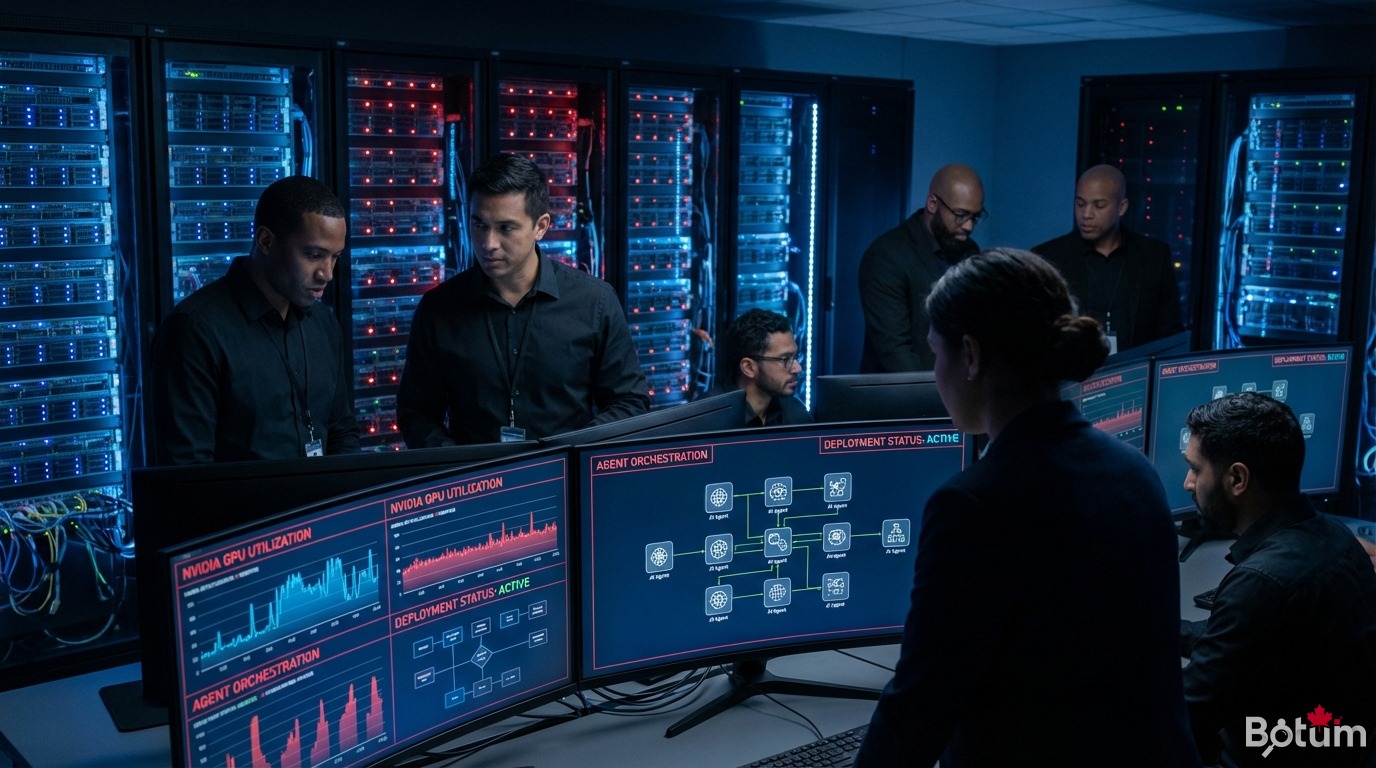
Organizational model: the AI Ops team
| Role | Responsibility | Profile |
|---|---|---|
| AI Ops Lead | SLA, incidents, GPU budget | Senior DevOps + LLM training |
| Prompt Engineer | Prompt optimization, evals | Python dev + linguistics |
| Data Steward | Data quality, GDPR, RAG | Data analyst + legal |
| Business Owner | Business KPIs, prioritization | Business director or manager |
| AI Security | Guardrails, audit, red team | SecOps + adversarial AI training |
BOTUM benchmark: a well-optimized customer support agent handles 500-800 conversations/hour on a single H100 GPU. Calculate your break-even vs. human agents at that ratio.
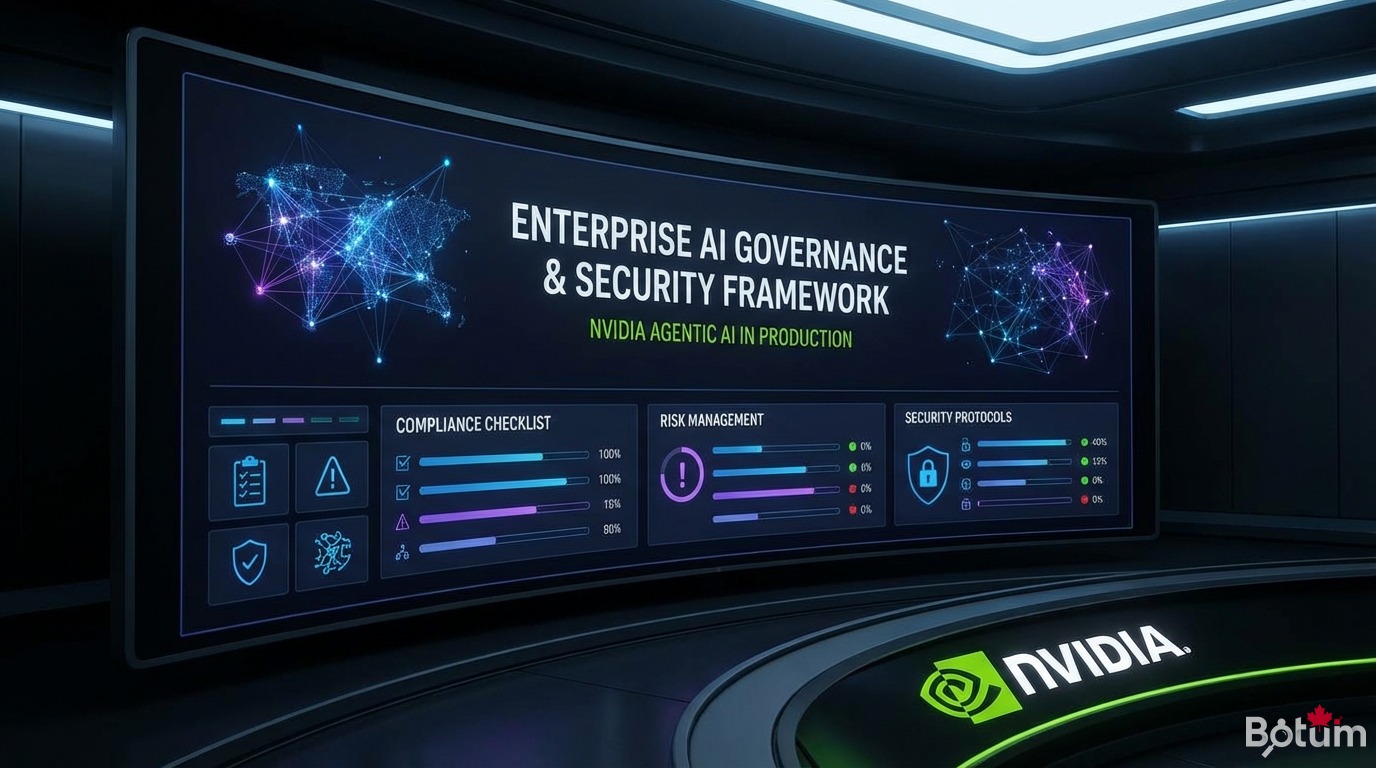
Phase 4: Governance — Control, audit, secure
Governance is not a phase that comes after production: it must be embedded from the pilot. But it is in production where it becomes critical.
BOTUM enterprise AI governance framework
- Acceptable use policy: what agents can and cannot do (documented, legally validated)
- Agent registry: inventory of all agents in production, their access, their capabilities
- Complete audit trail: every agent decision traced, timestamped, exportable for audit
- Human-in-the-loop: human validation process for high-impact decisions
- Regular red teaming: quarterly adversarial prompting tests, report to leadership
- Model update process: validation procedure before every LLM update in production
GDPR and data protection compliance
- Never send PII to an external LLM without consent
- Local NIM or private VPC for sensitive data: healthcare, finance, HR
- Right to explanation mandatory if agent affects an individual
- Log retention recommended: 12 months minimum
- DPO involved in every new agent capability
Classic mistakes and how to avoid them
| Mistake | Symptom | Solution |
|---|---|---|
| Too big too fast | Pilot on 20 use cases in parallel | Max 2 use cases in phase 1 |
| No guardrails | Agent answers anything out of scope | NeMo Guardrails mandatory |
| Unprepared data | RAG hallucinating 30% of the time | Data audit before pilot |
| No business champion | Adoption < 20% after 3 months | Business owner required |
| Model lock-in | Total dependency on GPT-4 | LLM abstraction (LiteLLM) |
| Ignoring GPU costs | Cloud bill 5x vs estimate | GPU FinOps from pilot day 1 |
| Forgetting security | Prompt injection by users | Adversarial tests pre-launch |
Final checklist — 20 questions before go-live
Evaluation & Architecture
- ☐ Does the use case have a measurable KPI and an identified business sponsor?
- ☐ Is the data audit complete (quality, scope, GDPR)?
- ☐ Is the NIM + orchestrator + RAG architecture documented?
- ☐ Have GPU costs been estimated and a cloud budget approved?
- ☐ Is a human fallback in place for edge cases?
Security & Compliance
- ☐ Is NeMo Guardrails configured and tested?
- ☐ Have prompt injection tests been conducted?
- ☐ Is the PII processing policy validated by the DPO?
- ☐ Is the audit trail active and exportable?
- ☐ Is the agent registry created?
Operations & Scale
- ☐ Is observability (traces, metrics, alerts) in place?
- ☐ Is a CI/CD pipeline with automated tests configured?
- ☐ Is the incident runbook written?
- ☐ Is the AI Ops team trained and on-call rotations defined?
- ☐ Has the rollback procedure been tested?
Adoption & Governance
- ☐ Is end-user training planned?
- ☐ Is a user feedback process in place?
- ☐ Has the acceptable use policy been communicated to all?
- ☐ Is a quarterly AI review committee scheduled?
- ☐ Is the scale-up plan documented?
📥 COMPLETE GUIDE — GTC 2026 · Article B5
⬇ Download the guide (PDF)🚀 Go further with BOTUM
This guide covers the fundamentals of enterprise agentic AI adoption. In production, every decision has its specificities — governance, security, GPU FinOps. BOTUM teams support CIOs from evaluation to go-live. Let us talk.
Discuss your project →