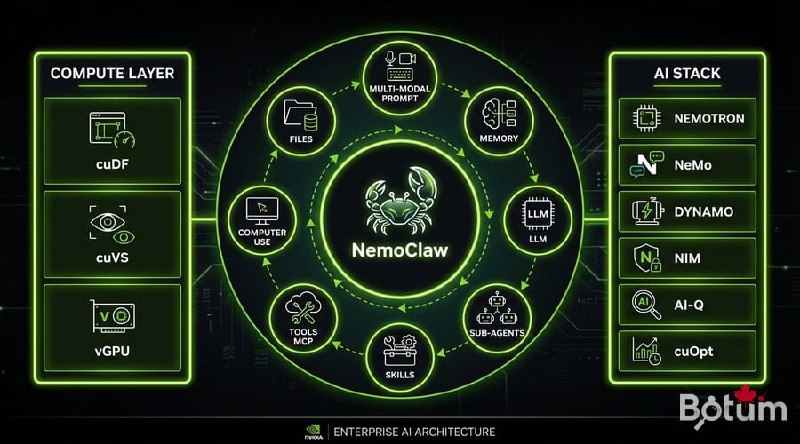
NVIDIA Agent Toolkit: The Enterprise Agentic Stack — GTC 2026 B3
Introduction — GTC 2026, the Agent Convergence
GTC 2026 marked a turning point: agentic AI is no longer a concept. It is infrastructure. Jensen Huang devoted a significant portion of his keynote to the NVIDIA Agent Toolkit — a complete ecosystem to deploy, secure and orchestrate AI agents at enterprise scale.
This B3 post of our GTC 2026 series breaks down the Agent Toolkit: what it contains, why it changes the game, and how your organization can adopt it.
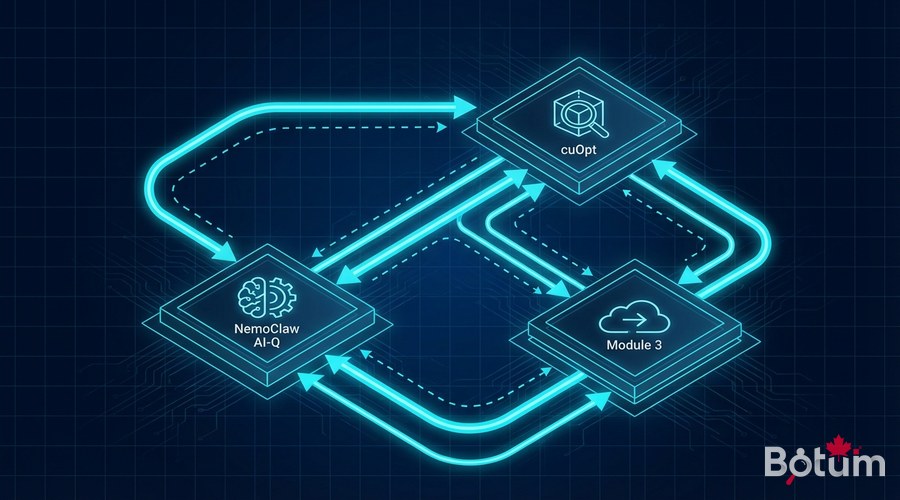
1. Agent Toolkit = NemoClaw + AI-Q Blueprint + cuOpt
The NVIDIA Agent Toolkit is not a single product. It is a 4-layer complementary stack:
NemoClaw — The Security and Governance Layer
- Native sandboxing: each agent runs in an isolated environment
- Least-privilege model: agents receive only the minimum permissions needed
- Built-in Privacy Router: automatic filtering of sensitive data before LLMs
- Complete audit trail: every action of every agent is logged
Security partners: Cisco, CrowdStrike, Google Security, Microsoft Security, TrendAI
AI-Q Blueprint — The Intelligence Layer
- Hybrid frontier + Nemotron architecture: dynamically routes between powerful and lightweight models
- 50% reduction in inference costs using Nemotron for repetitive tasks
- Native connectors: SharePoint, Salesforce, SAP, ServiceNow, SQL/NoSQL databases
- Long context: indexing and semantic search across large knowledge bases
cuOpt — The Optimization Layer
- Logistics route optimization (supply chain, deliveries, field service)
- Resource planning: team allocation, machine scheduling, cloud capacity
- Workflow scheduling: maximize throughput of agentic pipelines
Nemotron — The Model Layer
- Multi-step reasoning (chain-of-thought, tree-of-thought)
- Tool use (function calling, API calls, codebases)
- On-premise deployment with privacy guarantees

2. The 31,000 Enterprise Partners
NVIDIA is not building the Agent Toolkit alone. 31,000 companies have integrated their systems into the NVIDIA ecosystem:
- Adobe — Creative agents: multimedia content generation and revision
- Salesforce — CRM agents: lead qualification, customer follow-up, auto outreach
- SAP — ERP agents: invoice approval, inventory management, financial analysis
- ServiceNow — ITSM agents: incident triage, L1/L2 resolution, SLA tracking
- Siemens — Industrial agents: predictive maintenance, digital twins
- Atlassian — DevOps agents: code review, sprint management, documentation
- Palantir — Analytics agents: decision ops, intelligence, risk management
Strong signal: when Adobe, SAP, Salesforce and ServiceNow all align on the same stack, the ecosystem has reached enterprise production maturity.
3. Why a Toolkit vs Isolated Agents
Before the Agent Toolkit, companies built agents case by case. The recurring problems:
- Inconsistent security: each team managed its own permissions
- Data silos: agents did not share common context
- High cost: each project paid the full LLM infrastructure overhead
- Impossible auditability: no unified trace of agentic decisions
The Agent Toolkit solves these 4 problems:
- A single security layer (NemoClaw) — the entire organization shares the same policies
- A shared context bus (AI-Q) — agents can collaborate and enrich each other
- A centralized inference router — cost optimization at enterprise scale
- A unified audit registry — GDPR/SOC2 compliance by design
4. Architect Adoption Guide — How to Implement
The question is no longer "should we adopt agentic AI?" — it's "in what order?"
Phase 1 — Foundations (Weeks 1-4)
- Deploy OpenClaw: local dev environment with Docker Compose
- Configure NemoClaw: access policies, sandbox isolation, Privacy Router
- Identify the pilot use case: high-volume, low-risk process
- Benchmark models: Nemotron vs GPT-4o vs Claude on your real data
Phase 2 — Pilot (Weeks 5-12)
- Build the pilot agent with AI-Q Blueprint as reference architecture
- Integrate internal data sources via native connectors
- Implement agentic monitoring: latency, accuracy, human escalation rate
- Validate ROI: measure productivity gain vs inference cost
Phase 3 — Scale (Months 4-12)
- Migrate to Vera Rubin if volume > 10,000 requests/day
- Deploy cuOpt for complex workflow optimization
- Build an 'Agent Ops' team: hybrid SRE and data science profile
- Establish the Agentic Center of Excellence: governance, standards, knowledge sharing
📥 COMPLETE GUIDE — GTC 2026 · Post B3
⬇ Download the guide (PDF)🚀 Go Further with BOTUM
This guide covers the fundamentals. In production, every AI agent deployment has its specificities. BOTUM teams help organizations evaluate and implement their agentic stack. Let's talk.
Discuss your project →