Hybrid Cloud Architecture for Canadian SMBs: The Balanced Approach
VPN, Azure Arc, PIPEDA, -35% costs — real hybrid architecture for 150-employee SMBs. Complete guide with BOTUM case study.
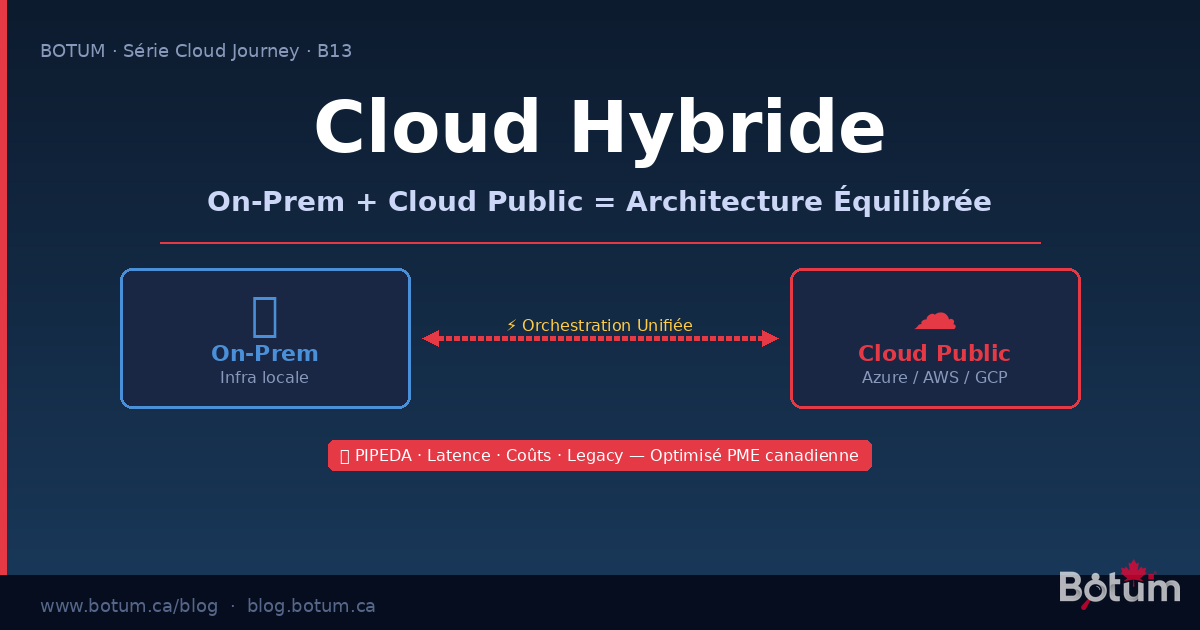
The term "hybrid cloud" is everywhere. But behind the buzzword, there's a precise technical reality: workloads running simultaneously on your on-premises infrastructure and a public cloud, orchestrated together through a unified management layer. Not two separate worlds — one coherent system.
That's the definition that matters for a SysAdmin or DevOps engineer. Not the marketing slide.
Why Canadian SMBs Choose the Hybrid Model
Full cloud migration isn't the right answer for everyone. Here are the 4 concrete reasons our clients cite most often:
1. PIPEDA and Quebec Law 25 — The Personal Information Protection and Electronic Documents Act imposes constraints on where your Canadian customer data can reside. Keeping certain data on-prem or in certified regions (Azure Canada Central, AWS ca-central-1) isn't paranoia — it's compliance.
2. Latency of critical applications — Your legacy ERP, your production database running at 2ms latency, your real-time manufacturing system: these workloads have nothing to gain in the cloud. Cloud network latency adds 5-20ms. On a SQL transaction, you feel it.
3. Real costs vs. estimated costs — Full cloud surprises CFOs. Egress (outbound traffic) costs money. High-frequency object storage costs money. Keeping cold data on-prem and using cloud for variable compute: that's where real savings materialize.
4. Non-migratable legacy applications — SQL Server 2008, AS/400 apps, CAD software that only runs on Windows bare-metal... That's the reality for Canadian industrial SMBs. Hybrid cloud lets you maintain them without blocking the rest of the organization.
The 3 Hybrid Patterns: Which One Fits Your SMB?
Pattern 1 — Extend (Burst to Cloud)
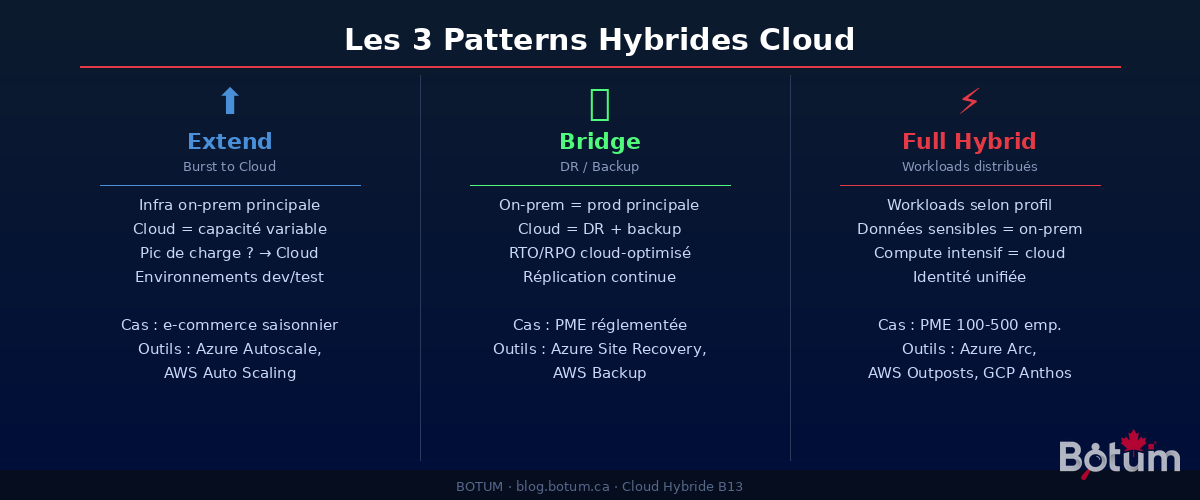
Your on-prem infrastructure handles the base load. The cloud absorbs peaks. Typical for seasonal e-commerce (Black Friday), nightly batch processing, dev/test environments. You pay for cloud only when you need it.
Pattern 2 — Bridge (DR/Backup)
On-prem stays primary. The cloud is your Plan B: disaster recovery, geo-redundant backup, continuous replication. RTO dropping from 4 hours to 45 minutes. Monthly cost: $300-800 CAD for a 100-server SMB via Azure Site Recovery or AWS Backup.
Pattern 3 — Full Hybrid (Distributed Workloads)
Each workload is placed according to its profile. PII data and regulated apps → on-prem. Intensive ML compute → cloud. Collaboration and messaging → SaaS. This is the most sophisticated and most cost-effective model at maturity. It also requires a real orchestration layer.
Recommended Tech Stack: Azure Arc, AWS Outposts, GCP Anthos
Here's the honest comparison of the 3 major hybrid management options:
| Platform | Model | Strengths | Ideal for | Cost |
|---|---|---|---|---|
| Azure Arc | Lightweight agent on your servers | Azure Policy, Defender, Monitor integration. Linux/Windows/K8s support | Existing Microsoft stack | $0 for basic management + cost of attached Azure services |
| AWS Outposts | Physical AWS rack in your DC | Ultra-low latency, native AWS services on-prem | Need AWS API on-prem | $10,000-30,000/month (dedicated rack) |
| GCP Anthos | Managed multi-cloud Kubernetes | GKE everywhere, integrated Istio, native multi-cloud | Kubernetes-first, multi-cloud | $0.10/vCPU-hour + infra |
Our recommendation for Canadian SMBs: Azure Arc is the most accessible entry point. If you already have M365, Azure AD, and Windows servers, Arc gives you a unified view without hardware investment. AWS Outposts only makes sense if you're massively AWS and have sub-millisecond on-prem latency constraints. GCP Anthos shines if your organization is Kubernetes-native.
Hybrid Networking: Site-to-Site VPN, ExpressRoute, Direct Connect — When to Use What
Site-to-Site VPN (IPSec/IKEv2)
- Cost: $30-150/month depending on volume
- Bandwidth: 1-10 Gbps max depending on equipment
- Added latency: 10-30ms (encryption overhead)
- Use when: traffic <500 Mbps, moderate latency tolerance, tight budget
Azure ExpressRoute / AWS Direct Connect
- Cost: $500-3,000/month (dedicated circuit + provider)
- Bandwidth: 1-100 Gbps guaranteed
- Latency: 2-10ms (dedicated fiber, no public internet)
- Use when: traffic >1 Gbps, latency-sensitive critical applications, continuously replicated databases
Our practical rule: VPN to start and for DR/backup workloads. ExpressRoute/Direct Connect when your bandwidth bill exceeds $200/month or your applications demand <5ms. The crossover point typically arrives around 500 Mbps of average daily traffic.
Hybrid Security: Unified Identity and Zero Trust
The traditional network perimeter no longer exists in a hybrid model. Your security posture must rest on 3 pillars:
1. Unified Identity
Azure AD/Entra ID (if Microsoft stack) or Okta (multi-cloud) as the central Identity Provider. SSO for all apps, on-prem and cloud. Mandatory MFA, risk-based Conditional Access. The user authenticates once — access adapts based on context (device, location, behavior).
2. Network Segmentation
Don't extend your flat on-prem network into the cloud. Micro-segmentation: each workload in its own subnet, strict NSG/Security Groups. East-west traffic (between workloads) must also be inspected. Azure Firewall or AWS Network Firewall as central hub.
3. Zero Trust Applied
Never implicit trust, always verify. Concretely: Just-In-Time access for admins (Azure PIM), secrets in Key Vault (never in plain text in configs), centralized logs in SIEM (Sentinel or Security Lake). For an SMB, the minimum viable zero trust is: MFA + Conditional Access + privileged access auditing.
Common Mistakes to Avoid
❌ Migrating everything at once — "We're moving everything to hybrid cloud in 3 months" invariably ends in budget overruns and network panic. Recommended approach: pilot 2-3 non-critical workloads, measure, adjust, then scale.
❌ Ignoring data latency — An on-prem database queried by a cloud app: every request crosses the VPN. Result: a 50ms app becomes 80ms. On high-volume transactional apps, that kills user experience. Rule: apps and their data in the same domain (cloud together, or on-prem together).
❌ Underestimating the network — The network is the backbone of the hybrid model. An undersized VPN, a saturated firewall, absent QoS policy: everything collapses. Recommended minimum network budget: 15-20% of total cloud budget.
❌ Forgetting cost governance — In a hybrid model, costs come from everywhere: cloud, connectivity, Arc/Anthos licenses, training. Implement Azure Cost Management or AWS Cost Explorer from day 1. Budget overage alerts at 80%.
Real Case — BOTUM: 150-Employee SMB, -35% in Costs
Industrial client, 150 employees, Montreal. Initial infrastructure: 40 over-provisioned VMs in Azure (rushed migration during COVID). Monthly bill: $18,000 CAD/month.
Hybrid stack deployed with BOTUM:
- On-prem repatriation: 12 VMs (ERP, production SQL databases, MES system) → Local Proxmox
- Azure Arc on Proxmox servers: unified management, Azure Policy, Defender for Servers
- Site-to-site Azure VPN: Fortinet on-prem + Azure VPN Gateway (Active-Active)
- Maintained in Azure: Azure AD, M365, Azure Kubernetes Service for web apps, cold object storage
- Cloud DR: Azure Site Recovery for critical on-prem VMs (45-min RTO)
Results after 6 months:
- Azure bill: $11,700/month (−35%)
- ERP latency: 55ms → 3ms (local database)
- PIPEDA compliance: Canadian customer data on-prem only
- Disaster recovery RTO: 4h → 45min
The key: don't start with ideological convictions ("all cloud" or "all on-prem"), but do the cost/performance analysis workload by workload.
🚀 Go Further with BOTUM
Hybrid cloud architecture, migration, security — BOTUM teams support Canadian SMBs.
Discuss your project →Download this hybrid cloud guide as a PDF.
⬇ Download Guide (PDF)